
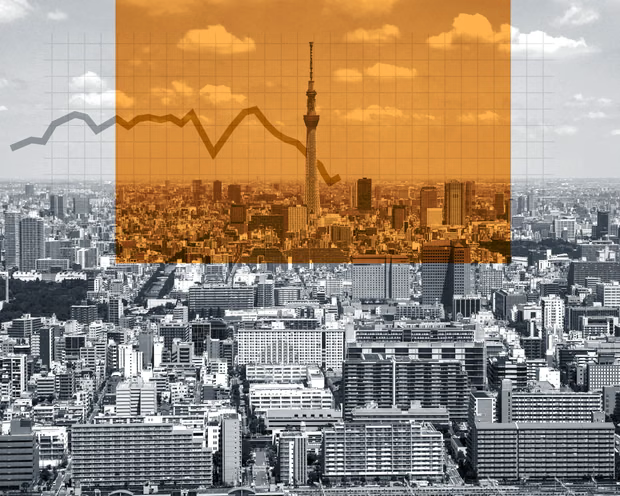
Post-Fukushima nuclear closures of dozens of reactors forced the country to rely heavily on imported fossil fuels
Japan is the world’s fifth-biggest emitter of greenhouse gases, but has had some success in reducing its carbon footprint. Composite: Prina Shah for the Guardian AFP / Getty Images
‘People are wrestling with the burden’: Japan pivots to focus on nuclear power ‘maximisation’ alongside renewables
 English
  French
https://www.theguardian.com/environment/2025/dec/31/japan-pivots-nuclear-power-maximisation-renewables
The stillness of a bitterly cold afternoon is broken by the swish, swoosh of three 50m-long blades, adjusting automatically to the tiniest shift in the direction of a dependable westerly wind that keeps them turning day and night.
From here, up on a mountain ridge in rural Fukushima prefecture in north-east Japan, the wind turbines stretch for miles. In the distance, you can see the outlines of the reactor buildings at the Fukushima Daiichi nuclear power plant, which is in the slow process of being decommissioned at a cost so far of $35bn (£26bn) almost 15 years since it suffered a triple meltdown after being struck by a magnitude-9.0 earthquake and a 15m (49ft) tsunami. Another nuclear plant further south stands idle.
But the 46 turbines that make up the sprawling Abukuma windfarm – the biggest onshore windfarm in Japan – could offer hope for a different future for the region’s energy supply. Built at a cost of ¥67bn (£310m), the facility went into full operation in April this year, weeks after Japan’s government previewed its strategic energy plan as it aims to achieve net zero by 2050.
The plan has been controversial with campaigners because it ditches attempts to reduce Japan’s reliance on nuclear power after the Fukushima disaster, calling instead for a “maximisation” of nuclear power, which will account for about 20% of total energy output in 2040: about 14 reactors have been restarted and the assumption is that 30 will be in full operation by then.
The post-Fukushima nuclear closures of dozens of reactors forced the country to rely heavily on imported fossil fuels: last year it was the world’s second-largest importer of liquefied fossil gas after China, and the third-largest importer of coal by volume. But the government’s energy plan envisages a share of between 40% and 50% for renewable energy – compared with just under a third in 2023 – and a reduction in coal-fired power from the current 63% to 30-40%.
Fukushima plans to become a leader in renewable energy – a shift that would have elicited derision before tsunami waves roared ashore on the afternoon of 11 March 2011, crippling the Daiichi plant’s backup power supply and triggering the world’s worst nuclear accident since Chornobyl a quarter of a century earlier. In its Renewable Energy Promotion Vision, the prefecture, home to 1.7 million people, aims to achieve 100% renewables by 2040, with a midterm target of 70% by 2030.
“Everyone in the prefecture is determined to reach the target,” said Takayuki Hirano of Fukushima Fukko Furyoku (Fukushima Wind Power Recovery), a joint venture funded by nine companies and led by Sumitomo Corporation. “That’s why there are so many subsidies available for solar, wind and other renewables. I think we’re going to make it happen.
“People have negative memories of nuclear power and Fukushima, and they’re still wrestling with that burden.” The wrecked atomic plant generated power for business, industry and homes in Tokyo, 150 miles to the south. Fifteen years on, some of the 160,000 people who were evacuated have returned home after atmospheric radiation levels were declared safe; but levels in other communities are still too high for people to go back permanently.
Content – from Justin McCurry – www.thegaurdian.com