
The Golden State’s clean energy use hit new highs in 2025. As the Trump administration abandons US climate initiatives, can California fill the void?
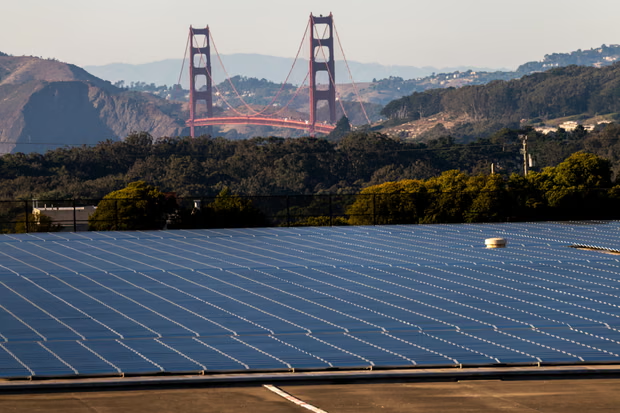
For the first time, clean energy provided 100% of the state’s power almost every day for at least some of the day in 2025. Photograph: David Paul Morris/Bloomberg via Getty Images
 English
  French
As officials from around the world met in Brazil for the Cop30 climate summit last month, the US president was nowhere to be found, nor were any members of his cabinet. Instead, the most prominent American voice in Belém was that of the California governor, Gavin Newsom.
During the five days he spent in Brazil, Newsom described Donald Trump as an “invasive species” and condemned his rollback of policies aimed at reducing emissions and expanding renewable energy. Newsom, long considered a presidential hopeful, argued that, as the US retreated, California would step up in its place as a “stable, reliable” climate leader and partner.
Among the talking points he used to demonstrate California’s leadership was its progress on renewable energy – and the battery capacity needed to store that power.
“We’re running the fourth-largest economy in the world [on] 67%, two thirds, clean energy on nine out of 10 days in 2025,” Newsom said. “Outside of China, there’s only one other jurisdiction in the world – California – that has as much battery storage implemented.”
The Golden state has transformed how it powers its main electrical grid in recent years, setting ambitious targets to create an emission-free grid by 2045 and investing heavily in solar, wind and battery storage. And as the federal government abandons climate initiatives, California seems poised to take on an increasingly important global role.
The state appears to have much to celebrate. Since 2019, the state has added 30,800 megawatts of clean energy and battery storage. And while natural gas still remains the top energy source in the state, that’s on the decline: California saw its largest-ever year-to-year drop in natural gas production this year.
Meanwhile, solar and batteries, which allow energy to be stored for later use, providing an alternative to gas, are stepping up to replace it, said Mark Jacobson, a Stanford professor and renewable energy expert: “This is a remarkable shift.”
Content from Dani Anguiano – Refer to below link for full content.